vrijdag 11 oktober 2013

Osram Addresses the LED “Green Gap”.

Ever heard of the “Green Gap” in LEDs?  This is the wavelength band that covers the range from about 520nm – 635nm where there is no commercially available semiconductor material that can be used to make efficient LEDs.  Unfortunately, the optimum green LED primary for display applications, 540nm and the optimum red display primary, 622nm, both fall in this gap.  While it is called the “Green Gap,” the gap actually covers green, yellow and orange wavelengths.
Osram Opto Semiconductors (Regensburg, Germany) addresses the green gap problem in an article in the September issue of Compound Semiconductor titled “Taking aim at the ‘Green Gap’.”  In this article, two authors from Osram, Andreas Löffler and Michael Binder, discuss the origin of the green gap and what Osram is working on to solve the problem.
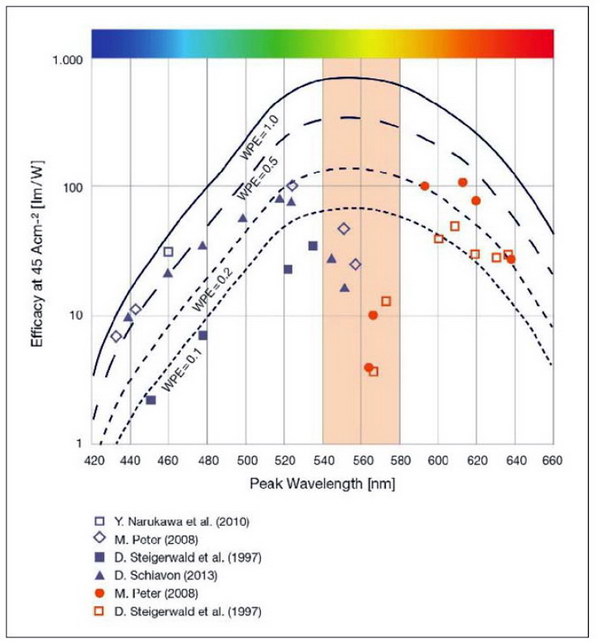

Osram LED Green Gap
Figure 1: Efficacy of III-Nitride [e.g. InGaN] (green [blue-gray] data points) and III-phosphide [e.g. AlInGaP] (red data points) LEDs with different wavelengths (data taken from recent publications). The blue lines represent the CIE 1924 [and 1931] luminosity function multiplied by the corresponding value of the wall plug efficiency (WPE). Marked in yellow is the green-yellow range, which is not adequately covered by either the III-nitrides or the III-phosphides. This is the essence of the green gap problem. (Source: Compound Semiconductor, October 2013)

Incidentally, this poor performance in the green for LEDs is the reason for hybrid projectors—you simply cannot build a bright projector  (2000 – 4000 lumens) with a green LED and a reasonable size microdisplay.  (Étendue raises its ugly head!)  A blue laser/green phosphor combination can produce a much brighter spot than a green LED to create the green primary of one of these projectors.  The higher efficiency and lower droop of red and blue LEDs can produce enough light to then balance the green to the desired color temperature.

So how do we make displays with RGB LEDs if we can’t match the optimum wavelength?  Well, the optimum is actually rather broad for green and red.  Acceptable green primary colors made by LEDs can have a peak wavelength anywhere from 520nm to 549 nm and acceptable red primary colors can be made with an LED anywhere 614 to 650nm region.  Peak wavelengths that are actually used are typically 525 nm for green and 623 nm for red.

more info here.


woensdag 9 oktober 2013

De Tunnel van de Toekomst.

De Fietstunnel tussen de Singel 1940 - 1945 en de Spaarnestraat in Oss is vanmiddag (9 oktober 2013 ) feestelijk geopend als Tunnel van de Toekomst.

De Tunnel van de Toekomst® is een innovatie die onderdeel uitmaakt van de Weg van de Toekomst. Het is de wereldwijd eerste toepassing van PleasantPass®. Een wetenschappelijk gefundeerde vinding, van het bedrijf PUBLICPASSES, een team van wetenschappers en kunstenaars onder leiding van prof.dr. Pieter Jan Stallen.

De Tunnel van de Toekomst® is een experiment, met een systeem dat bij lancering in 2013 nog niet ‘af’ is, maar verder verbeterd en ontwikkeld zal worden. Met hulp van gebruiker en sociale omgeving, jouw hulp dus! Niet alleen zal de content zich door nieuwe bijdragen van tunnelgebruikers blijven vernieuwen. Ook de technische kant van het systeem staat open voor verbetering: de website, de (mobiele) software enz.


dinsdag 8 oktober 2013

Sony HMZ-T3W wearable display is up for pre-order in the US, costs $999

DNP Sony HMZ T3

US buyers that want to swap large displays for wearable screens might want to check out Sony's online store, where the HMZ-T3W is now available for pre-order for $999. Hirai and Co. claims this third iteration of the head-mounted display comes with dual OLED monitors that simulate sitting 65 feet away from an enormous 750-inch screen. The wireless version that's up on Sony's website -- a wired version might come out in the future -- can stream content up to 7 meters away from the source, although it's still tethered to a small battery pack. One of our favorite features, however, is that it plugs into smartphones and tablets via MHL or micro-HDMI. The units won't start shipping until next month, but those who'd like to watch movies or game à la Geordi La Forge better start writing that letter to Santa.

DNP Sony HMZ T3


BLAZING VISUALS. THE NAME SAYS IT ALL.

The signmaking company “Blazing Visuals” based in Point Pleasant in the USA lives up to its name in the shop window. A flaming digital signage installation generates suitably high attention levels.


The “Digital Signage Creator” of the digital signage provider Gefen and a special film provided by 3M applied to the window turn the store front into a blazing inferno of green and yellow. The owner of “Blazing Visuals” is delighted by the attention, as the installation has resulted in increased numbers of visitors in front of and inside his store and has created a major buzz in the area.


vrijdag 4 oktober 2013

Fontys Hogeschool informeert studenten.


Intel NUC in gebruik bij Fontys Sporthogeschool

De Intel® NUC is een heel praktisch apparaatje voor toepassingen op het gebied van Narrowcasting. De studenten aan de Fontys Hogescholen krijgen informatie over onder andere hun roosters, en lesuitval snel en scherp gepresenteerd op grote interactieve schermen. Gekoppeld aan een Intel® NUC uiteraard.


LeftClick is een jong bedrijf dat  webapplicaties en narrowcasting-oplossingen ontwikkelt.
Hiervoor maken ze vaak gebruik van de Intel® NUC. De capaciteit, de prijs-kwaliteitverhouding en de goede programmeerbaarheid zijn volgens Jochem de Bie van LeftClick de doorslaggevende redenen.

Voor de Fontys Hogescholen ontwikkelde LeftClick diverse toepassingen om de studenten snel, gemakkelijk van specifieke informatie te voorzien. Op de onderwijslocaties hangen grote 65 inch schermen in de aula´s of de kantines. In de gangen hangen kleinere schermen.  In onderstaande video laat LeftClick zien hoe zo´n scherm functioneert op Fontys Sporthogeschool in Eindhoven.

De aan- of afwezigheid van docenten, informatie over de colleges van die dag, maar ook de bustijden op de specifieke locatie zijn makkelijk en snel afleesbaar voor de studenten.  


donderdag 3 oktober 2013

Learning to Teach through Mixed Reality.

Imagine this.  A mixed-reality environment designed to provide pre-service student teachers and teachers looking to improve their skills a chance to try out new strategies, without messing up with real kids!   TLE TeachLiveE™ was developed by researchers at the Synthetic Reality Lab located at the Institute for Simulation & Training at the University of Central Florida. It  looks like a great training tool for young college students who are planning to take on the challenge of a career in education.  

With modifications, the TeachLivE system looks like it would be a good tool for building skills of principals-in-training, as well as others who plan to work in the schools, such as  future school psychologists, school nurses, and school resource officers.

Below is a description of the system from the TeachLivE website, along with some videos and related links. 

(Be sure to watch the video of MILES, near the end of this post. MILES is a similar application designed to support the training of social workers and therapists, and features that could be used to enhance the TeachLiveE system.)

"TLE TeachLivE™ is a mixed-reality classroom with simulated students that provides teachers the opportunity to develop their pedagogical practice in a safe environment that doesn’t place real students at risk. This lab is currently the only one in the country using a mixed reality environment to prepare or retrain pre-service and in-service teachers. The use of TLE TeachLivE™ Lab has also been instrumental in developing transition skills for students with significant disabilities, providing immediate feedback through bug-in-ear technology to pre-service teachers, developing discreet trial skills in pre-service and in-service teachers, and preparing teachers in the use of STEM-related instructional strategies." -TeachLivE 


"There is a child with ADHD, there is a child who is going to take out their cell phone, and do something with his cell phone right there for our pre-service teacher, if our preservice teacher is not paying attention to that child.  So what they've tried to do is actually program different types of children into each simulated avatar." -Dr. David Rock, Dean, School of Education, University of Mississippi. 


RELATED A good overview of the use of virtual worlds and environments for learning.At 7:44, Stephen Bronack, of Learn NC, provides an overview of TeachLivE at TEDX Greenville. TeachLivE is in place at Clemson University in S.C.


woensdag 2 oktober 2013

VJ ZERO


Point of Art
VJ ZERO :: live contact : hello@vjzero.com soundtrack : losing faces by Kardinal (goog records)


Interactive Month.


CBS Outdoor is koploper als het gaat om interactieve buitenreclame-campagnes en wil u graag kennis laten maken met deze manier van adverteren. Daarom is de maand oktober omgedoopt tot “Interactive Month”! De Interactive Month vindt plaats in week 40 t/m 43 waarbij er verschillende interactieve mogelijkheden worden aangeboden op buitenreclame. U kunt bijvoorbeeld denken aan het omtoveren van een abri tot een winkel, NFC (Near Field Communication), het toevoegen van WiFi hotspots aan uw campagne en het inzetten van een e-mailcampagne.


dinsdag 1 oktober 2013

Digital Advertising.

The growth of digital advertising may be slow, but that’s because some marketers may see traditional advertising as a ‘safe’ choice. The audience and demographic is known by the company, and these types of advertisements would be rather straight-forward. If  a company wanted to look into going digital, a whole range of questions would need to be answered first. What type of ad are we placing? Where should we place it? Will it interact with the user?

Gartner Report Statistics
According to a recent Gartner Report, digital or online advertising was at the top of online marketing budgets, at 12.5%. With digital advertising continuing to expand its reach, the big question still remains: Can digital advertising replace all traditional advertising? 

Digital Out of Home Awards 2013.

Unilever Lynx, BMWi and Adidas Boost Take Best-in-Show At 2013 Digital Out of Home Media Awards.

Grand visual won Best-in-Show in the “Industry Vertical” category for its “Lynx Apollo” campaign for Unilever’s  Lynx brand (which is branded Axe in the U.S.), which enabled spectators in six public places in the U.K. to project their own faces into the visor of a 12-meter tall astronaut projected on a big screen. The campaign also won the Consumer Packaged Goods category.

kbs+ scored Best-in-Show in the “Platforms” category for its augmented reality effort for client BMW North America’s new i line with an in-window execution that offered an “i window into  the near future,” visually transforming the reflections of all the cars passing  by on New York City’s Sixth Avenue into the futuristic versions of automobiles — all in real-time. The video generated 500,000 views to the BMWUSA YouTube channel. Leads for BMWi vehicles rose 52% in 10 days. The campaign also won the Augmented Reality campaign award.

Iris Worldwide took Best-in-Show honors in the “Best Venue/Location Based Execution” for a campaign for Adidas’ Boost running shoe that literally enabled marathon runners power the energy required to display personalized motivational messages and finish times on screens along the route of the 2013 Santiago de Chile Marathon.